OEE: The Standard KPI for Manufacturing Productivity
OEE – Overall Equipment Effectiveness – combines three factors into a single number that tells you how efficiently a machine or production line is running: availability (is it running when it should be?), performance (is it running at rated speed?) and quality (is it producing good parts?). A world-class OEE is generally considered to be 85% or above. Most facilities starting IoT monitoring find their actual OEE is significantly below what they assumed.
How Sensor-Online Calculates OEE in Real Time
Sensor-Online collects the raw signals needed for OEE from machine sensors, counters and production line interfaces — then calculates the three components continuously using the built-in JavaScript engine:
- Availability — calculated from machine run/stop signals, planned production time and recorded downtime events
- Performance — derived from production count sensors or pulse counters compared against the ideal cycle time
- Quality — calculated from reject counters or manual quality inputs recorded via the API
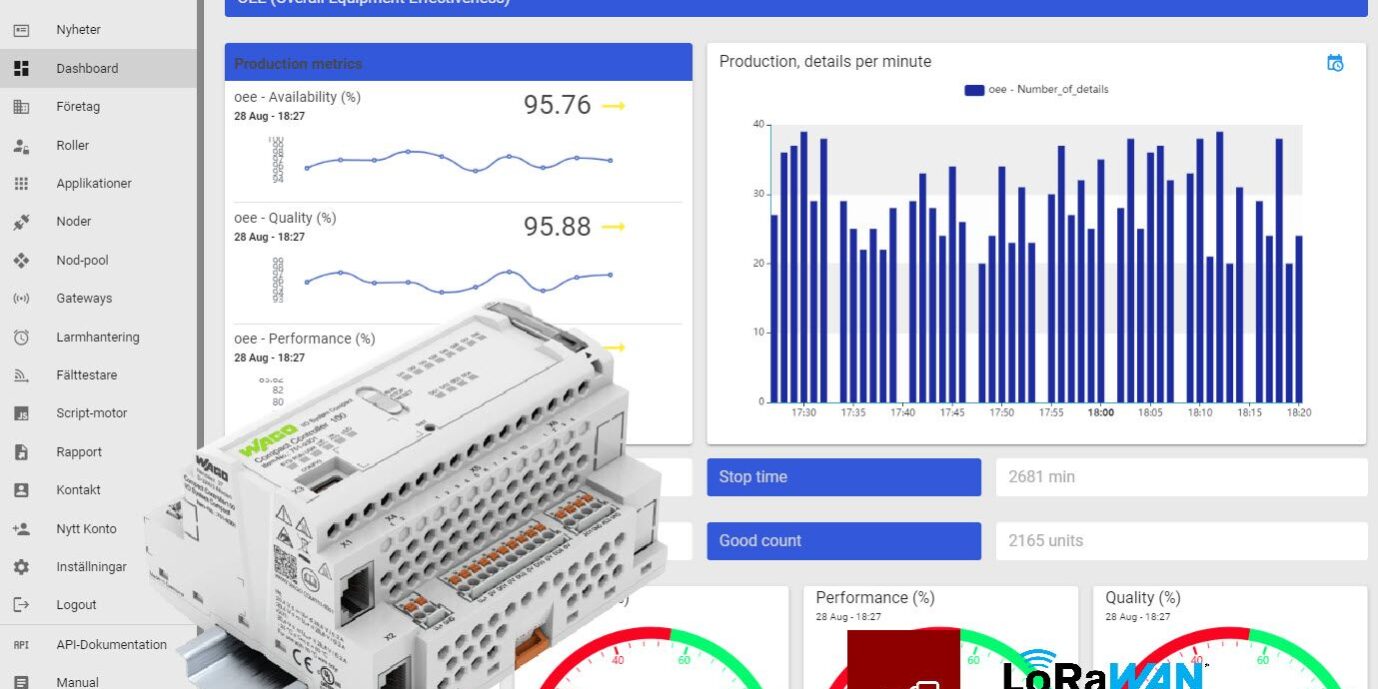
The resulting OEE value is displayed as a live KPI widget on a Sensor-Online dashboard, updated every time new data arrives from the machine.
Connecting Machines to Sensor-Online for OEE
Machines can be connected using several approaches depending on existing hardware:
- LoRaWAN I/O sensors — digital input sensors that read run/stop and count signals from the machine’s control panel or proximity sensors, no PLC modification required
- Modbus TCP/RTU — read directly from the machine’s PLC if Modbus communication is available, giving access to cycle counts, fault codes and speed data
- OPC-UA — for modern machines with OPC-UA servers, providing standardised access to all process variables
- Milesight UC300 — a versatile IoT controller with analog, digital and serial interfaces that can be installed next to almost any machine without PLC access
OEE Dashboard and Alerting
A well-designed OEE dashboard in Sensor-Online shows current OEE alongside the individual Availability, Performance and Quality breakdowns, plus a Pareto chart of the top downtime reasons. This makes it immediately clear what to address first to improve overall equipment effectiveness.
Sensor-Online’s alarm engine triggers notifications when OEE drops below a configurable threshold — for example, sending an SMS to the shift supervisor when OEE falls below 70% during a production shift.
From Single Machine to Factory-Wide OEE
Starting with OEE monitoring on one critical machine is the most common approach. Once the data collection and calculation logic is established in Sensor-Online, the same configuration can be replicated across an entire factory floor by adding more sensors to the same gateway and duplicating the JavaScript calculation scripts.
FAQ: OEE Monitoring with IoT
Do I need to modify my PLC to connect to Sensor-Online?
Not necessarily. LoRaWAN I/O sensors can read run/stop and count signals from a machine’s electrical panel without any PLC modification. Modbus and OPC-UA connections require that the PLC has an available communication port, but no changes to the control program are needed.
How accurate is IoT-based OEE compared to MES systems?
For machines where signal sources are well-defined (clear run/stop and count signals), IoT-based OEE calculation in Sensor-Online matches MES accuracy. For highly complex multi-step processes, a full MES may offer more detailed tracking, but the setup cost is significantly higher.
Can Sensor-Online push OEE data to our ERP or production reporting system?
Yes. Via the REST API, MQTT or a Node-RED integration, OEE values and underlying signals can be forwarded to any ERP, MES or BI system in real time.
Learn more about industrial IoT solutions or explore Sensor-Online’s platform capabilities.