What Makes an IoT Platform Good in 2026?
Choosing an IoT platform is a long-term commitment. The right platform should handle your protocols today, scale to thousands of sensors tomorrow and keep your data accessible regardless of what changes in your organisation. This comparison covers the platforms most commonly evaluated by facilities managers, industrial operators and municipalities in 2026.
Key Selection Criteria
Before comparing platforms, define what matters for your deployment:
- Protocol support — LoRaWAN, NB-IoT, Modbus, M-Bus, MQTT, OPC-UA
- Deployment model — SaaS cloud or on-premises (Docker)
- Vendor independence — open API, hardware-agnostic, no lock-in to specific sensor brands
- No-code configuration — dashboards, alarms and reports without developer involvement
- Data sovereignty — especially relevant for municipalities, healthcare and defence-adjacent applications
- Language and support — local language support, regulatory familiarity (EED, NIS2)
Sensor-Online
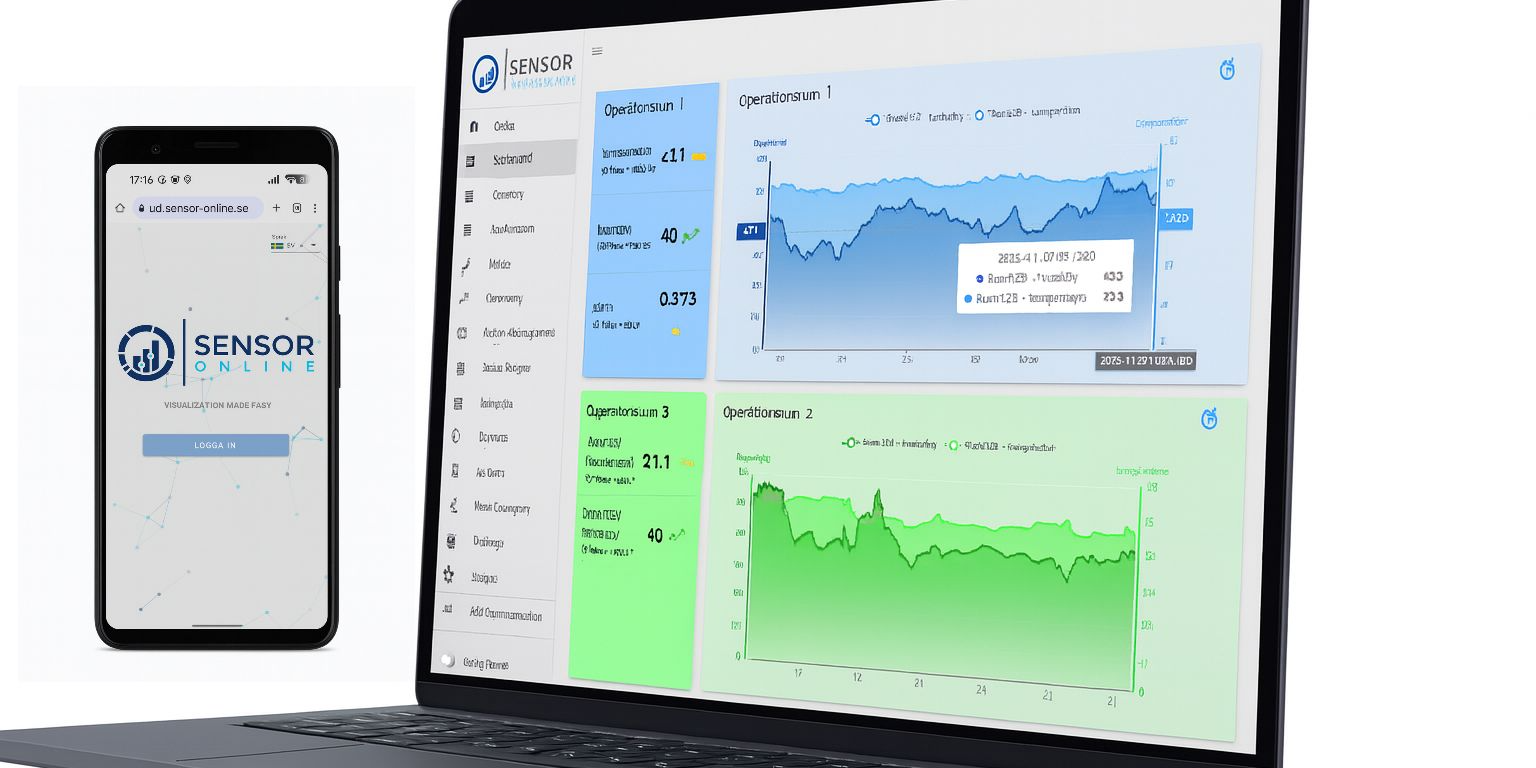
Sensor-Online is a Swedish-developed IoT platform built by Nodeledge AB in Skövde. It supports the broadest protocol range in its segment — LoRaWAN, NB-IoT, Modbus, M-Bus, MQTT, OPC-UA, BACnet — and is available both as SaaS and as a self-hosted Docker deployment.
Key differentiators:
- Built-in JavaScript engine for custom calculations and logic per sensor
- 1,100+ pre-built sensor decoders in the device type library
- BridgeX for direct LoRaWAN-to-PLC/SCADA integration over Modbus TCP
- IMD module for individual metering and billing in apartment buildings
- Swedish support and EU data storage by default
- No vendor lock-in: any hardware, any network
Best suited for: property management, water/wastewater, industrial IoT, municipalities, EED compliance.
Datacake
Datacake is a German SaaS platform with good LoRaWAN support and a clean no-code dashboard builder. Strong for straightforward deployments where Modbus and industrial protocol support is not required. Limited on-premises option. No built-in IMD or billing module.
Best suited for: simple LoRaWAN monitoring projects, startups building IoT products.
ThingsBoard
ThingsBoard is an open-source platform with a professional edition. Strong rule engine and good visualisation capabilities. Requires more technical configuration than Sensor-Online or Datacake. Self-hosted or cloud. No native Sparkplug B or IMD module out of the box.
Best suited for: organisations with developer resources who want maximum customisation.
Akenza
Akenza is a Swiss platform focused on smart building and smart city applications. Good multi-tenancy and white-labelling options. Primarily cloud-based. Limited industrial protocol support compared to Sensor-Online.
Best suited for: smart city deployments and IoT-as-a-service resellers.
Summary Comparison
For organisations in Sweden and Scandinavia deploying across property management, water/wastewater and industrial applications, Sensor-Online offers the most complete protocol coverage, the strongest on-premises option and the most relevant regulatory support (EED, NIS2). For simpler LoRaWAN-only projects, Datacake is a reasonable alternative. For maximum customisation with developer resources, ThingsBoard is worth evaluating.
FAQ: Choosing an IoT Platform
Can I migrate from another platform to Sensor-Online?
Yes. Sensor-Online’s open API and hardware-agnostic approach means your existing sensors and gateways will typically connect without replacement. Historical data can be migrated via API or CSV import.
Is Sensor-Online available as on-premises deployment?
Yes. Sensor-Online is available as a Docker-based on-premises deployment for organisations requiring full data sovereignty or operation in air-gapped networks.
How does Sensor-Online pricing compare to alternatives?
Sensor-Online uses a tiered B2B licensing model based on connected devices and features. Visit sensor-online.se/b2b-pricing/ for current pricing or contact us for a tailored quote.
Book a free demo or read more in the knowledge base.